
Home/Services/Product configurator development
Custom product configurator development
If your customers can't see what they're ordering, someone in your office is drawing it for them. A configurator moves that work to the buyer — and turns an approved design into a structured order rather than an email.
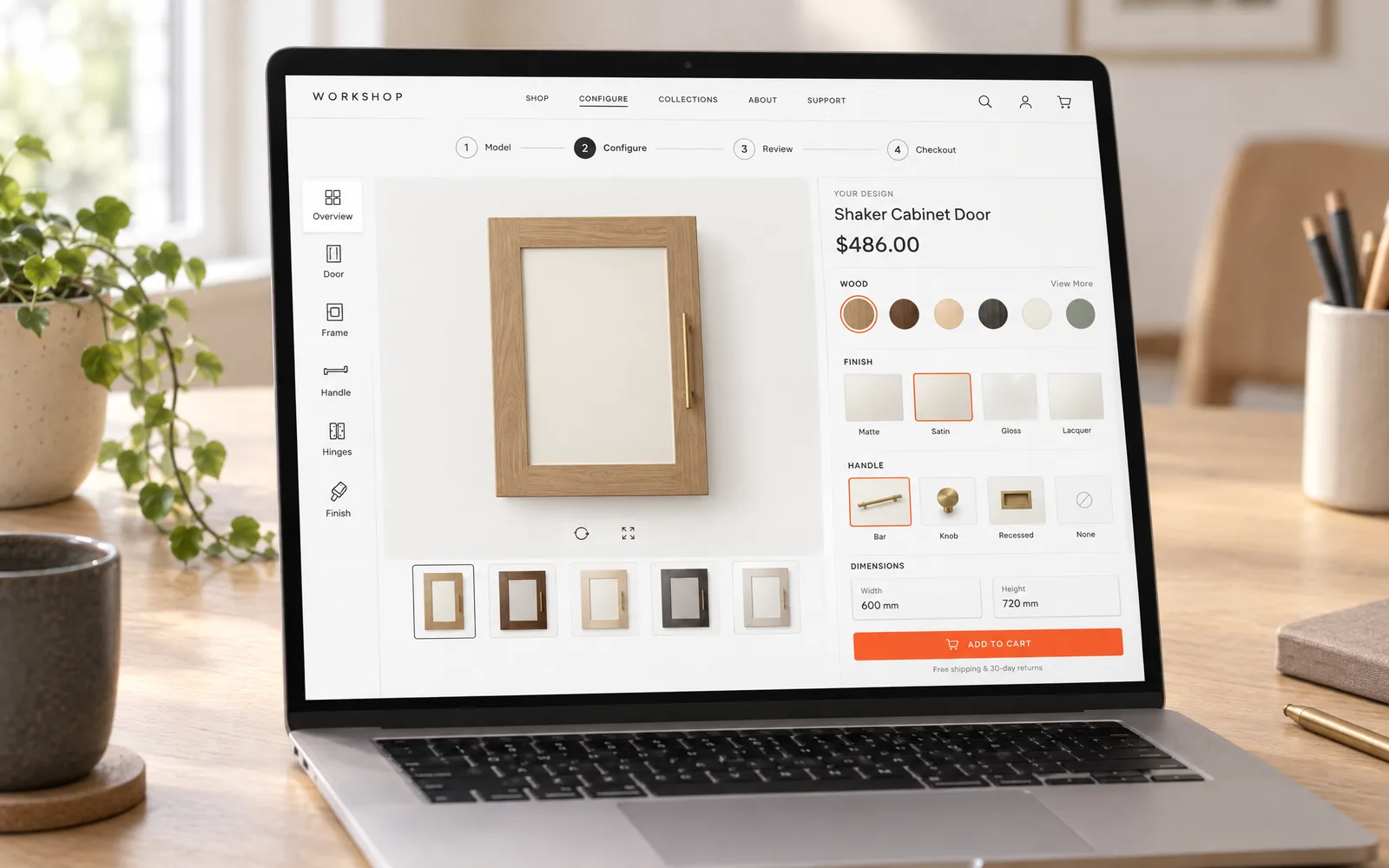
What a product configurator actually has to do
Most configurator plugins let a shopper pick a colour and a size. That is not what a manufacturer needs. A configurator that earns its place carries the rules your business already runs on, and produces something the next system can act on without interpretation.
- Real units and real geometry. Millimetres or inches, not arbitrary canvas pixels.
- A rules engine. Minimum and maximum dimensions, incompatible option pairs, material-dependent thicknesses, stock limits — enforced in the interface, not in an email afterwards.
- Live pricing. Price per area, per part, per option, per finish, with quantity breaks and margin rules, updating as the customer moves a handle.
- Bill of materials. The configuration resolved into actual parts and quantities, ready for purchasing and production.
- A quote or order that carries the configuration — structured data your ERP, your CRM or your production sheet can read, not a screenshot.
- Production output where the process needs it, generated from the same geometry the customer approved.
Where configurator projects usually go wrong
Almost every failed configurator fails on catalogue scope. Teams badly underestimate how much product data has to come with the tool — every option, every rule, every price break, every material, every incompatibility. The 3D is rarely the hard part. The catalogue is.
The second failure is the handover. If the configuration arrives at your team as a PDF that someone then re-enters, the configurator has moved the work rather than removed it. The output format is a scoping question, which is why the first call is about what comes out of the system rather than what it looks like.
What you get
- A configurator embedded in your own site, under your branding, on your domain
- An admin area where your team manages options, rules, materials and pricing without touching code
- Structured orders delivered to your existing systems by API, webhook or export
- 2D or 3D preview — whichever your product actually needs
- The full source, handed over at the end
Common questions
How much does a custom product configurator cost?
Most builds fall between a few weeks and six months of work, and the price is fixed before anything starts. What moves it is rarely the visual side — it is how many products, options and pricing rules have to be modelled, and how deeply it has to integrate with your existing ordering systems.
Can it integrate with Shopify or WooCommerce?
Yes. A configurator can run as a Shopify app or theme app extension, as a WooCommerce plugin, or as a standalone application that pushes completed orders into whatever you already use. The right choice depends on where your checkout lives.
Do we need 3D, or is 2D enough?
Many products sell perfectly well with a fast, accurate 2D preview, and 2D is cheaper to build and faster in the browser. 3D earns its cost when depth, material finish or assembly genuinely affect the buying decision. We decide this in the first call rather than defaulting to 3D.
Can it connect to our ERP?
Yes, and it usually should. A configurator that cannot see stock, current pricing or lead times will drift out of step with the business within months. Integration can be API, webhook or scheduled sync depending on what your system supports.
Who owns the code?
You do. The source is handed over at the end of the build.
Tell me what your customers should be able to design.
If your process today is an email, a sketch, and somebody rebuilding it by hand afterwards — that's the problem I work on.
or email hello@bytefold.io